Digital dollars and tokenized institutional credit are two of the fastest-growing pools of capital in onchain finance, and in June 2026 they intersected in a way that signals to onchain allocators where the next wave of real-world asset (RWA) flows is heading. Ethena, the protocol behind the $5B USDe synthetic dollar, selected Centrifuge as its tokenization partner through a competitive infrastructure RFP and allocated $200M+ of USDe reserve capital to the Janus Henderson Anemoy AAA CLO Fund (JAAA), the tokenized version of Janus Henderson's flagship $28B AAA-rated collateralized loan obligation (CLO) ETF available on Centrifuge. It is the first time USDe has reached for collateral outside crypto-native strategies as Ethena approved a meaningful amount of reserve capital to be earmarked for RWAs. The pressing matter for RWA market participants is how allocators gain access to the product and why Ethena's initiative favors managers who ship a full DeFi delivery stack rather than merely a token.
Ethena and Janus Henderson Are Buying Access to Each Other's Markets
The deal runs in both directions - an RWA allocation from a crypto-native and crypto utility token allocation from a TradFi manager. Janus Henderson, with roughly $480B in assets, took a strategic position in Ethena's ENA governance token, adopted USDe for its own treasury cash management, and signaled regulated USDe-linked exchange-traded products targeted for the second half of 2026. Each side is buying access to a market the other already occupies. Ethena needs to broaden USDe's backing beyond delta-hedged crypto perpetual swap and basis trades, strategies that are purely crypto-correlated. As the common theme and value-driver of RWAs in DeFi, low-duration AAA-rated credit lowers the risk profile of the reserve and makes the USDe synthetic dollar more robust to institutional holders and users. Janus Henderson sets precedent for gaining direct access to a $300B and growing stablecoin allocator base through its Ethena partnership. This is a distribution channel that an off-chain ETF wrapper simply cannot reach.
The momentum shows up in the data. As of mid-June 2026, RWA.xyz pegs the tokenized credit category at north of $5B in distributed value against nearly $24B in represented value, the latter a proxy for how much credit sits on blockchain rails and could migrate into DeFi, but is not currently utilized as such. Centrifuge is the fastest-climbing of the leading credit platforms on that table, up nearly 60% over 30 days to $736M in Total Value Locked (TVL) while the two larger platforms ahead of it contracted over the same window. JAAA itself sits near $690M in value across seven networks including Ethereum, Solana, Base, Arbitrum, Avalanche, BNB Chain, and Stellar, up nearly 65% in TVL (which is akin to Assets Under Management for JAAA) over 30 days.
Onchain Access to JAAA Runs Through Regulatory Setup
This is where allocators should focus, because the friction to access the product is make or break. Accessing JAAA is not a standard swap on a decentralized exchange (DEX), rather it is a regulated subscription process gated by the necessary KYC/AML and investor compliance checks. Nonetheless, this all happens in a DeFi-native interface rather than a traditional brokerage interface. Centrifuge runs a one-time investor verification flow with identity checks powered by Shufti Pro that, once completed, makes an investor eligible across open onchain investment pools, with a published timeline of roughly 5 to 7 minutes for supported jurisdictions and 1 to 2 days where a country of citizenship or incorporation falls outside automated onboarding. Onboarding to a specific pool then requires signing a subscription agreement directly with the issuer, and only after the fund admin approves does the investor's wallet address get whitelisted in the Centrifuge app, at which point subscriptions and redemptions clear in USDC against a fund that offers daily liquidity. The design of that process onchain is what previously limited meaningful RWA access, as the controls were weak and too off-chain oriented. This allocator onboarding process has been improving incrementally month by month across the industry for the last year as institutional investors and DeFi groups who effectively behave like institutional investors (such as Ethena and Sky) become more forward-adopting of RWA strategies.
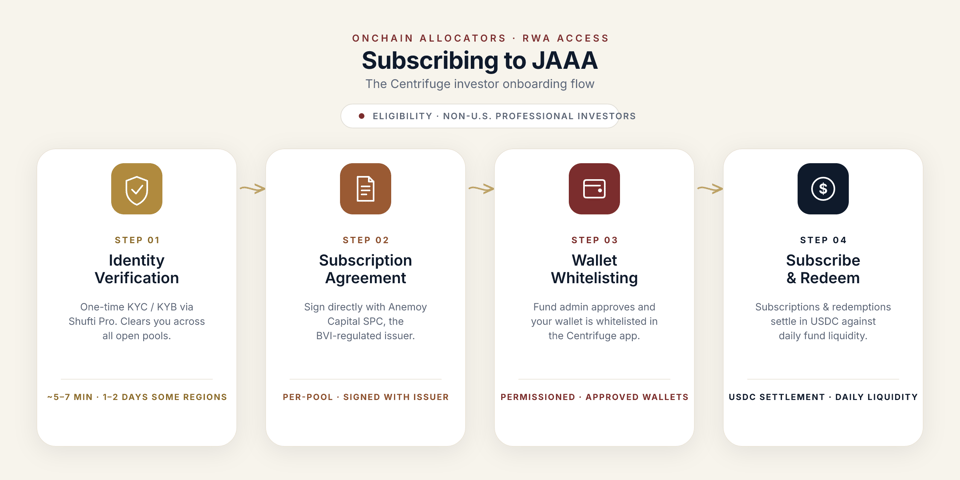
The access structure underneath JAAA is what reads as institutional-grade rather than a generic RWA token. The JAAA token represents shares in a fund issued by Anemoy Capital SPC Limited, domiciled in the British Virgin Islands and regulated under the BVI Securities and Investment Business Act overseen by the BVI Financial Services Commission, with eligibility restricted to non-U.S. professional investors. The product is accessible on 7 public blockchains with permissioned access controls in which subscriptions are limited to whitelisted wallets. Allocators gain exposure to the senior AAA-rated tranche of CLOs in the fund, historically the most resilient layer of the capital stack, usually chosen for capital preservation, floating-rate income, and low correlation to traditional bonds. The regulatory stack can be summarized with this checklist: a named regulator, a named issuer, a named manager, and enforced investor access gating.
DeFi Delivery Is the Product, and the CLO Exposure Is the Commodity Underneath
Janus Henderson is capturing meaningful market share as one of the few investable institutional-grade products outside of the Treasury & Money Market cohort. Like being the star Wide Receiver on a pass-first football team, Janus receives nearly all of the investor interest because JAAA is one of very few on the field. Ethena could have bought a competitor's CLO ETF because very few others exist onchain - and Ethena (and other major onchain allocators and capital suppliers) is not going to move reserve capital off-chain into fiat to purchase ETFs on NYSE.
Workflows already exist to settle RWA trades in stablecoins and for those assets to be composed into onchain products. JAAA can do all of this, while competing ETF managers are not even in the accessible universe. Adding to this composability, Centrifuge's deRWA token standard produces wrapped RWA token formats like deJAAA and deJTRSY to package the asset into something DeFi protocols can plug into directly. This setup enabled Resolv to deploy up to $100M of JAAA as actively managed, leveraged collateral on Aave Horizon earlier in 2026. Aave usage and broader DeFi utility integration is something that TradFi managers probably aren't thinking about when they think of "tokenization." Nonetheless, those integrations are what incentivize onchain allocators to deploy meaningful capital into the underlying product, producing a flywheel effect on the product's TVL growth. All of that is additional opportunity for AUM and performance fee capture to the issuing asset manager.
Tokenizing the fund is table stakes. Building the ecosystem that lets onchain allocators use it is where the value accrues.
Why Institutional Credit Keeps Pulling Onchain Inflows
Tokenized credit supply continues to expand with Securitize running a competing AAA CLO product, Apollo's multiple diversified credit offerings with Securitize, Centrifuge, and Coinbase Asset Management, Tradable's individual corporate loans and notes, Figure's HELOCs securitized and accessible on Hastra, and Maple's syrupUSDC standing as one of the single largest collateralized crypto lending-backed assets. So why is Janus Henderson's product pulling capital over these? First-mover advantage compounds in this category, and by Centrifuge's account JAAA was the first AAA-rated CLO fund brought fully onchain and the fastest tokenized fund to reach $1B in assets under management (AUM), primarily due to a handful of big-ticket allocations from onchain institutions. That head start translates into integrations, and every protocol that has already wired deJAAA in as collateral raises the switching cost of choosing a newer entrant. Ethena was able to earmark up to $330M allocations into JAAA through its investment and risk committees (including DeFi guardian LlamaRisk), beginning with the $200M allocation.
It should be noted that a few days after Ethena's JAAA allocation, the stablecoin issuer announced a $250M investment into the Securitize AAA CLO Tokenized Fund (STAC). This is a similar offering as JAAA held with BNY Mellon and sub-advised by BNY's subsidiary, Insight Investment. The CLO space is getting more competitive but still acting like a duopoly, all things given. The first-mover advantages favor JAAA and STAC for the foreseeable future as onchain allocators run deep diligence processes and require the top brand names for their own first RWA investments.
A Standing Bid for Onchain Credit
The signal in this deal is not that Ethena likes CLOs. The signal is that an onchain protocol with billions in deployable reserves like Ethena will choose a regulated tokenized fund over an off-chain equivalent whenever the onchain version exists, and that creates a standing bid for compliant, well-structured tokenized credit at a time when the supply of true institutional-grade product is thin. The industry has shown that the token is the easy part, and the defensible position comes from the token's surrounding ecosystem (access point, liquidity, collateralization, composability) delivering the whole stack into key DeFi venues.
Massive Distribution Opportunity for TradFi Managers
— Peter Gaffney, Head of DeFi
This article is for informational purposes only and does not constitute investment advice. Eligibility for products like JAAA or STAC is restricted and jurisdiction-dependent, so verify your own status before acting.